Are you curious about current automation and robotics solutions in the baking industry? Are you wondering which manufacturing steps are most relevant to automate and which technologies are best suited? Do you have investment projects and are questioning the relevance of your choices? Would you like to learn more about these automation-related topics?
In any case, it is with a desire to share our technical expertise that we have written this article dedicated to automation solutions in the baking industry, for the production of bread, viennoiseries, pastry, and other snacking products..
Hopi consulting is the only engineering consultancy fully specialized in the baking industry. This deliberate focus on a single industry enables us to deliver concrete, in-depth expertise and to guarantee tailor-made solutions. Our global approach covers equipment, utilities, and infrastructure, offering our clients the benefit of shared know-how and experience that define our strength and uniqueness. We speak the same language and instinctively understand our clients’ challenges.
The introduction of robotics into baking industry manufacturing processes impacts all stages, from production to packaging, and involves numerous challenges. Working conditions, OPEX and productivity, CAPEX and investment levels, product quality, hygiene, and production flexibility must all be carefully considered in order to make the right decisions. Investing in robotic solutions is not a trivial matter: success can become a powerful lever for improvement and profitability, while failure will undoubtedly result in constraints and losses.
The introduction of robotics is a recurring topic among our clients; this article therefore aims to present winning investment scenarios, as well as the paths to avoid.
Which robots for which applications in the baking industry?
Naked products
The robotization of handling naked products (raw dough pieces, shaped products, proofed, baked or cooled products that are not yet packed, etc.) introduces specific constraints related to direct contact with the product. By nature, these products are delicate, sometimes sticky, coated or decoratedwith toppings, and often exhibit significant variability in shape, weight, or texture.
These operations require particular care to preserve product integrity, visual appearance, and, in some cases, internal structure. Robotization must therefore be implemented with full awareness of these constraints, and only when productivity gains are clearly demonstrated through increased production rates, reduced material losses, quality improvements, or enhanced working conditions due to the reduction of repetitive manual tasks.
Gripper type :
The choice of gripper is a key factor in the project’s success. Several technologies exist today: :
Vacuum gripper :
Widely used for relatively stable and non-sticky products, this solution consists in placing several suction cups on the upper surface of the product. Once held by vacuum, the product can be handled and transported. It is an ideal and robust solution for the demolding of many bakery and pastry products with smooth surfaces, such as molded products including sandwich loaves or brioches.
Conversely, this solution is not suitable when the product features surface decoration such as glazing, toppings, egg spray, or seeds, as is the case for buns for example. In such situations, an alternative technology is required.
Needle gripper :
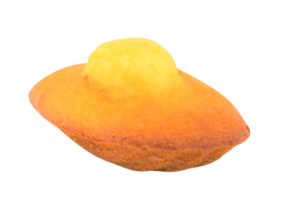
A traditional and proven solution, this option uses fine needles or claws that penetrate the product, allowing it to be transferred without risk of dropping. It is particularly well suited for small butter and eggs yellow dough pastries such as madeleines, as well as brioches or milk rolls. This approach also enables the handling of surface-decorated products such as cakes or muffins.
The solution is especially suitable for seeded products, such as buns topped with sesame seeds. This technology minimizes visible marks and product deformation..
Combined vacuum/needle gripper :
To provide even greater reliability, it is possible to combine these two technologies: the product is then held simultaneously by suction cups on its upper surface and by lateral needle. This option can prove advantageous when the risk analysis shows that relying on either solution alone is too critical for example, when the product surface is too variable or when handling speeds are too high.
This solution most closely replicates human handling. It is particularly well suited for delicate and decorated products, as it minimizes marks and deformation. However, it is more demanding, technically complex, and higher in cost making it a reliable choice for high production rate projects.
Type of robots being considered :
Applications for naked products mainly focus on two types of solutions, designed to operate in environments with high hygiene requirements (wet or flour-dusty areas):
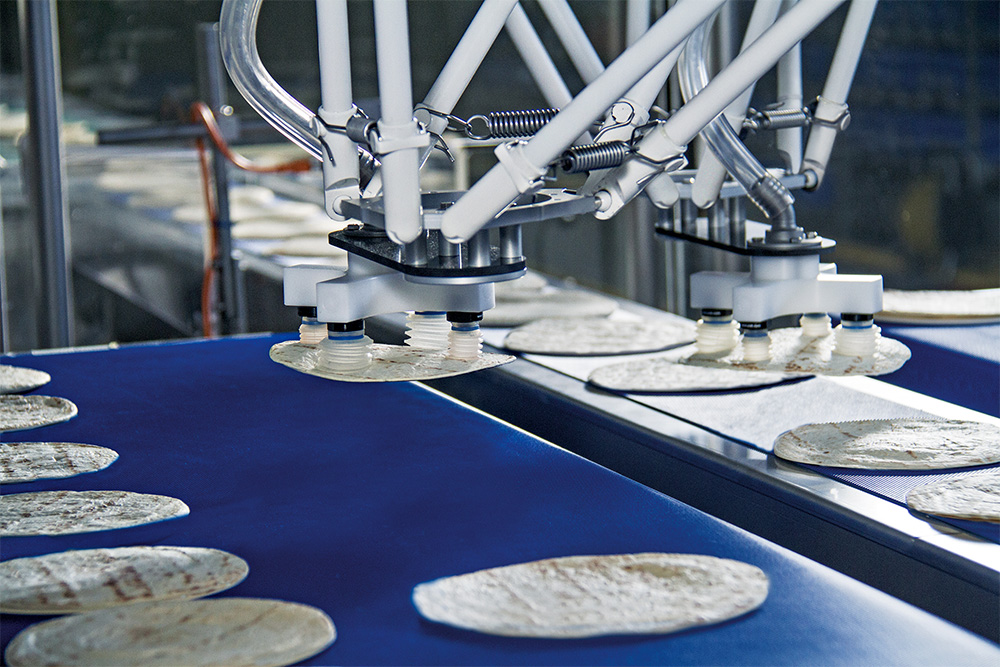
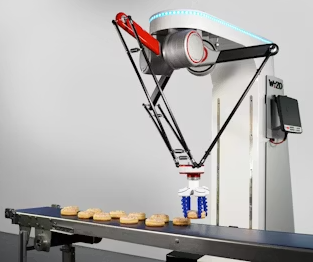
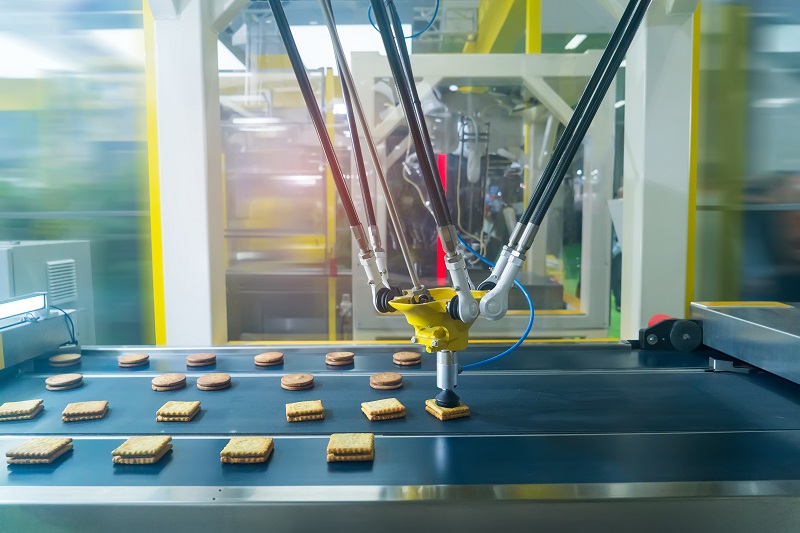
Delta Robot :
This solution provides high production rates and rapid movements for single, lightweight products.
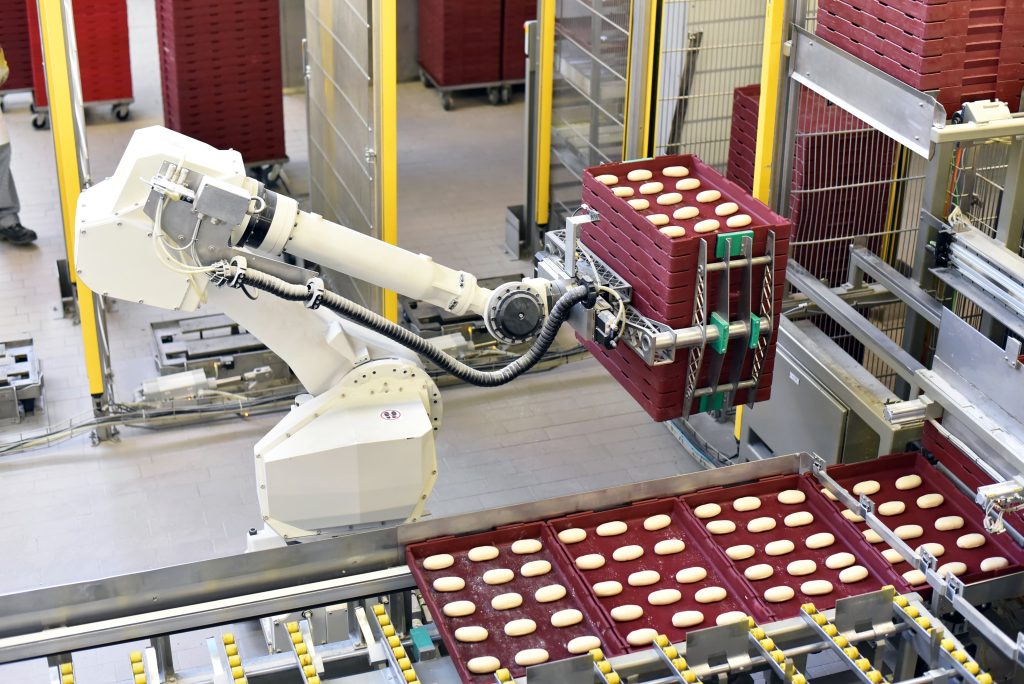
6 Axis Robot :
Favored when flexibility, handling of multiple formats, or integration into complex environments is required. This solution is also suitable for handling heavier loads, such as large bakery and pastry products, but especially containers like bins or trays.
The robotization of unpackaged products is particularly relevant at the beginning of the production line, as it allows simple and repetitive manual operations to be replaced. It also opens the door to innovation through handling capabilities that are both complex and fast — far beyond what human operators can realistically achieve.
Robotization fully demonstrates its value upstream of the packaging stage, once products are stabilized and cooled. This may involve arranging and organizing a dispersed product flow before feeding it into primary packaging machines such as flow pack wrappers or thermoforming machines.
Advantages:
Higher productivity and increased throughput
Improved repeatability
Enhanced hygiene by limiting human contact
Reduced physical strain and musculoskeletal disorders (MSDs)
Better control of labor shortage risks for this type of task
Drawbacks:
Higher investment compared to handling inert items
Larger floor space requirements
Risk of limited flexibility when managing multiple formats
More complex maintenance, commissioning, and operation
Risk of limited scalability for future innovations
Examples of applications:
Depositing dough pieces or shaped viennoiseries onto baking trays or oven nets
Bread scoring on oven nets or peel boards
Pick-and-place of products for loading onto a lugged conveyor feeding a flowpack machine
Product transfer between lines or towards packaging equipment
Handling of trays, plates and molds
Many production stages in the baking industry use handling units such as molds and baking trays for the baking process, trays for proofing, or plates and racks for cooling.
The handling and transfer stages of these units often display all the characteristics of operations for which automation is a highly effective solution:
Repetitive, high-speed operations where the operator does not add value
Operations that are too physically demanding for an operator due to heavy and bulky loads
Simple operations with little variability from one format to another
Gripper type:
The automation of these stages is facilitated by the absence of direct contact with the products, and the grippers are relatively simple, as they are designed to handle elements that are often standardized.
Type of robots being considered:
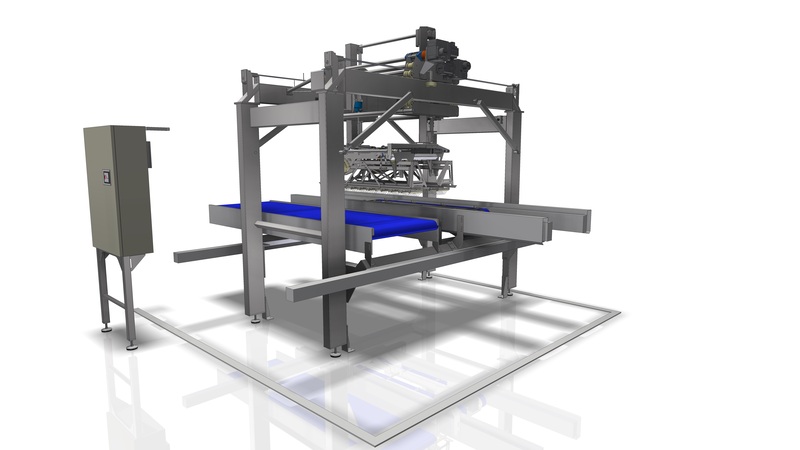
Several types of robots can be considered for these applications, ranging from a simple Cartesian system to a six-axis articulated arm. These choices will have an impact on cost, maintenance requirements, and the ability to accommodate new formats.
Advantages:
High throughput and consistent repeatability
Reduced physical strain and risk for operators
Improved process reliability and enhanced hygiene
Reallocation of operators to higher value-added tasks
Drawbacks:
Initial investment to be anticipated
Potential rigidity depending on the type of robot selected
Requirement for a controlled environment and well-managed process flows
Skilled personnel required for operation and maintenance
The long-term reliability of rolling-rack handling systems (molds, trays, plates…) is directly dependent on their condition. There is a clear correlation between productivity losses in these systems and rolling rack defects resulting from use, such as impacts or breakage.
It is therefore essential to define an appropriate tolerance range within the robotic solution and to monitor the condition of the rack.
A few examples of applications:
Loading and unloading trays or plates onto baking trolleys or racks
Palletizing bins of semi-finished products
Changing formats of baking trays or mold on a production line
Handling of cardboard boxes, wrapped products or pallets
The automation of these elements concerns packaging, palletizing, depalletizing, and automated storage operations. Since cardboard boxes, wrapped products, and pallets are standardized and often rigid, they are generally easier for a robot to handle.
However, several challenges remain:
In the case of handling flexible wrapped products that are more difficult to grip, such as multipacks of small products like brioche rolls: these bags are unstable, and the products can move inside them.
In the case of handling frozen products: condensation and moisture on the packaging can lead to productivity losses in robotic systems.
Gripper type:
Mechanical grippers or claws :
A cost-effective solution, well suited to repetitive tasks on pallets or conveyors.
Vacuum grippers :
A suitable solution for handling wrapped products or lightweight packaging.
Type of robots being considered:
Cartesian robot :
A cost-effective solution, well suited to repetitive tasks on pallets or conveyors.
6 axis robot :
Flexible for handling different formats, orientations, or positions within storage areas.
Applications for which automation adds no value
Some operations in the baking industry offer little benefit from automation, either due to their simplicity, excessive variability, or because simpler mechanical solutions already exist.
A few examples of low-value applications:
Operations already optimized by simple mechanical solutions, such as retractable conveyors or gravity-fed systems.
Handling of very fragile or highly variable products, where human intervention remains more suitable and provides higher quality.
Simple, low-throughput operations that do not justify the investment and complexity of a robot.
Tasks requiring visual judgment or fine real-time adjustments, which are difficult to replicate with a standard robotic system.
Workstations with high format variability and no standardization, leading to setup times incompatible with the expected gains.
Seasonal operations where the return on investment is difficult to achieve, for example placing the “fèves” inside the pie for the “Galette des Rois” French tradition.
Our technical opinion
Automation in the baking industry should be viewed as a tool to enhance overall performance, rather than as an end in itself. Its relevance depends on striking a balance between cost, productivity, working conditions, and product quality.
CAPEX Investment
The investment cost should not be evaluated only based on the price of the robot. The analysis must take into account the entire ecosystem.
Workspace Integration
The integration of a robot should be considered from the design phase of the line or carefully adapted for an existing installation. Key factors include footprint, operator flow, and accessibility for maintenance and cleaning. A technically high-performing solution that is poorly integrated can quickly become an operational constraint, slow down production, or complicate day-to-day operations.
Throughput and Formats
The number and variability of formats are key considerations when integrating a robot. The greater the number of formats, the higher the risks: slower throughput due to changeover times, increased complexity leading to breakdowns or additional costs. Ideally, a robot operates on a stable format or a limited number of formats to ensure performance and reliability. When variability is too high, manual operations may remain the most reliable and efficient solution.
Products, Quality, and Consistency
The weight, fragility, and variability of products strongly influence the choice of robot and gripper, as well as the movements and trajectories required.
Strain, Ergonomics, and Safety
Safety remains a top priority: work areas must be protected by barriers, except when using collaborative robots (cobots).
Cobots provide a safe alternative for collaborative tasks: thanks to their sensors and force-limiting features, they can work directly alongside operators without compromising safety, while offering flexibility and easy integration into existing production lines.
Hygiene and Cleanability
In the baking industry, sanitary requirements are strict. Robots and grippers must be easy to clean and accessible, made from materials suitable for food contact and resistant to humidity.
Technical and Industrial Maturity
If not properly prepared, the integration of robotics can become a barrier to industrial performance. Indeed, introducing these systems to a site requires changes in maintenance practices as well as new approaches to analyzing technical defects. For example, issues in upstream production often manifest as visible defects at the end of a robotic line. Attention must therefore be focused not on the stage where the technical incident occurs, but on earlier stages—a task that remains complex.
At the same time, the maintenance team must be trained and develop skills in automation. The integration of a robotic workstation must therefore be part of a broader process combining human resources, with a focus on change management and the acquisition of new technical competencies.
Never invest without first clearly defining your current and future needs in detail. The specification book is an essential tool during the pre-project phase and when consulting suppliers: it ensures that all risks are managed and aligns your investment with success.
The most effective investment strategy is to add a manual workstation at the end of a robotic line. This solution avoids costly format changeovers while allowing the handling of complex and/or niche product ranges.
Company overview - DEMAUREX
DEMAUREX is a Swiss company specializing in robotic technologies applied to industrial packaging, particularly in automated handling and packaging systems. It is recognized as a pioneer in Delta robotics, a type of fast and precise robot used for pick-and-place systems on production lines.
Some Key Figures:
Founded: 1983
Employees: 65
Location: Vufflens-la-Ville, Switzerland
Turnover: €24 million (2024)
Factory Area: 6,500 m²
Pick & Place Robots Installed: Over 3,500 worldwide
Today, DEMAUREX is one of the most renowned manufacturers of Pick & Place systems, with over 3,500 robots installed worldwide. Its expertise covers robotic grippers capable of handling both naked products and wrapped products, as well as integrated cartoning systems.
Focus on DEMAUREX’s technical offering
High-Speed Handling of naked Products
The tool and technology are key to success in handling pastries or bread in primary packaging.
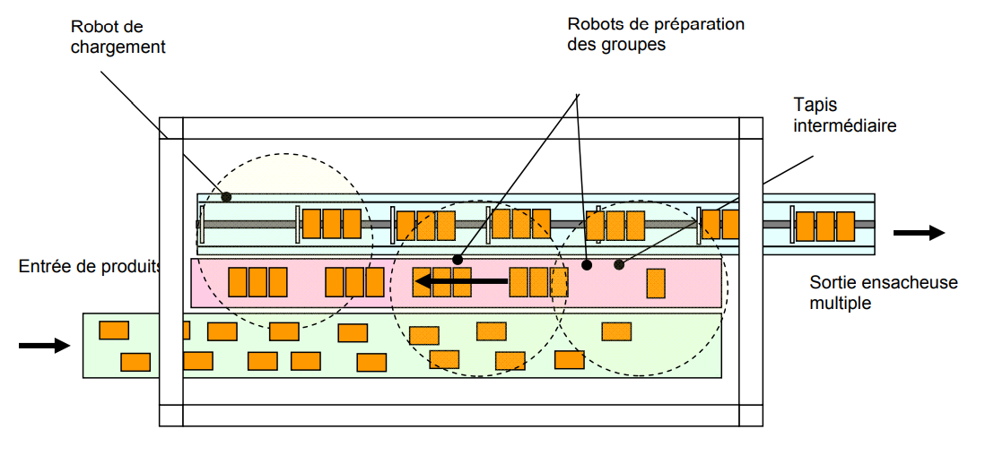
DEMAUREX often groups products before placing them into their final packaging in a single operation. To achieve this, the counterflow method is the most effective and ensures complete grouping.
2. Mechanical grippers
Mechanical grippers allow products to be handled without marking or damaging them, unlike needle-type grippers. They ensure gentle and hygienic transport of bread, pastries, or viennoiseries along production lines.
Advantages of mechanical grippers:
No marks on the products
Direct alignment with individual bagging machines
Maintains product orientation
High-speed placement with tracking
Flow balancing directly handled by the robotic cells
3. Complete Clamshell Packaging Lines
DEMAUREX also offers complete pastry packaging lines using Clamshell-type products or thermoformed blisters.
Advantages of Clamshell packaging lines :
Dynamic depiling and placement
Suitable for all types of formats
Fully vision-controlled operation
Focus on the Delta Wyzo Cobot – DEMAUREX
The Wyzo is a collaborative “cobot/sidebot” robot designed by DEMAUREX, a pioneer in Delta robotics, and has been recognized for its innovative design. Compact and agile, it can work side by side with human operators without safety barriers, thanks to advanced sensors that continuously monitor the environment.
With high-speed operation (up to 90 cycles per minute) and a design optimized for easy integration into production lines, it combines industrial performance with safe collaboration.
Advantages of the Cobot Wyzo :
High speed, up to 90 cycles per minute
Able to operate safely within a shared workspace
Relocatable within the factory (seasonal production)
Integrated cameras for managing up to three dynamic product flows
The Wyzo cobot is primarily used for pick-and-place, sorting, and product handling applications. In the baking industry, it is also suitable for light assembly, quality control, or packaging operations. Its compatibility with vision systems and various end effectors and grippers allows it to adapt easily to diverse and evolving tasks.
Compared to other cobots, the Wyzo stands out for its high speed, significantly exceeding that of conventional collaborative robots, while remaining safe for close human interaction. Its compact, barrier-free design reduces floor space and simplifies integration into existing production lines. Additionally, its flexibility, ease of programming, and ability to switch quickly from collaborative mode to high-performance mode make it a particularly effective solution for dynamic industrial environments.
Conclusion
Automation in the baking industry today offers numerous opportunities to enhance line performance, reduce physical strain, and improve workplace safety. However, each project comes with its own constraints regarding products, formats, throughput, space, and operations, making a thorough technical analysis essential from the outset.
Technological choices must be guided by actual needs, the existing environment, and anticipated future developments. Industrial robot, cobot, grippers, or level of automation: each decision directly impacts the performance, reliability, and longevity of the installation. When well designed, automation becomes a true industrial lever; when poorly sized, it can quickly become a constraint.
This is the philosophy behind the solutions offered by DEMAUREX, a recognized player in robotics and automation for baking industry lines. Their pragmatic, use-oriented approach provides tailored solutions, whether integrating a robot into an existing line or designing a complete, scalable system.
Hopi Consultingsupports you in this process by offering tailored, independent technical guidance in a 100% baking industry approach.
This article was written by Hopi Consulting, engineering specialists dedicated to Bakery, Pastry, and Viennoiserie. Discover more articles on the Hopi Consulting blog, focused on the baking industry.
Did you like this post ?
Share on Facebook
Share on Twitter
Share on Linkdin
Interested in this article?
Receive our monthly newsletter dedicated to the world of baking industry …
We will never send Spam nor share your email with third parties… promised!