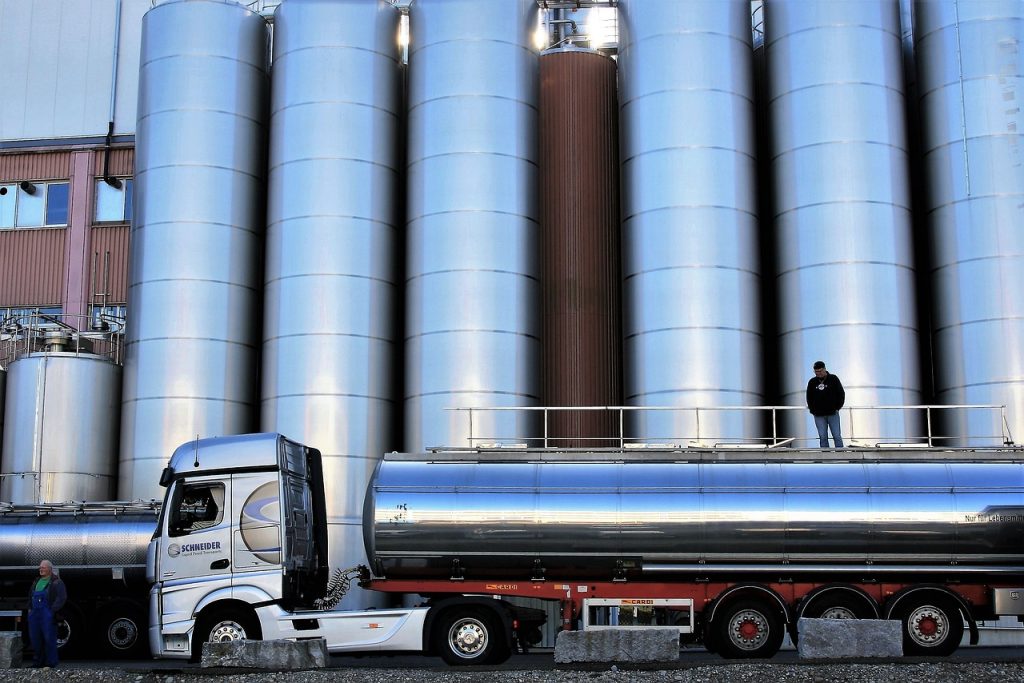
It seems important to us to provide technical insights into the stage involving the handling of dry ingredients. The choice of technologies, solutions, system sizing, and dosing accuracy are essential questions to produce bread, viennoiseries, pastries, biscuits, etc…). Mastery of dosing dry ingredients such as flour, sugar, salt, mixes, is a fundamental requirement in the baking industry.
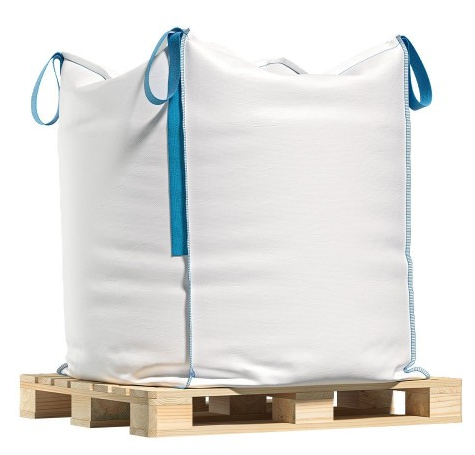
If you choose a bulk-bag discharging solution, make sure to always require a bag emptying hopper in the installation. This does not affect its primary function and will provide you with additional flexibility.
In the case of complex ingredients with challenging abrasiveness or flow properties, standard solutions will need to be enhanced with discharge aids: massagers or pneumatic vibrators, for example, can effectively address these issues.
Feel free to contact us to discuss your challenges, and let’s work together to find the technical solution that best meets your specific needs.
Bag-Sack discharging solution
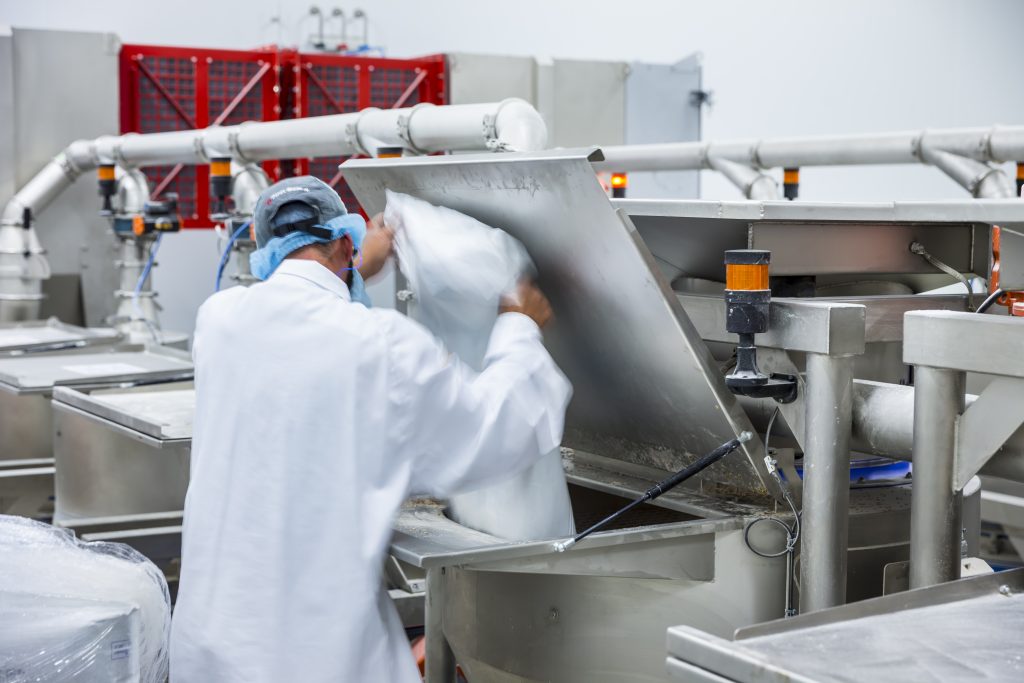
Regarding sack discharging solutions, the key challenge at this stage is to make the workstations fully ergonomic for these repetitive and demanding tasks performed by operators. Workstation design, lifting assistance systems, and automated suction removal of empty bags are topics we suggest addressing in this context.
Whether you are implementing bulk bag or small bag emptying solutions, do not forget to anticipate future developments by planning space for additional emptying stations.
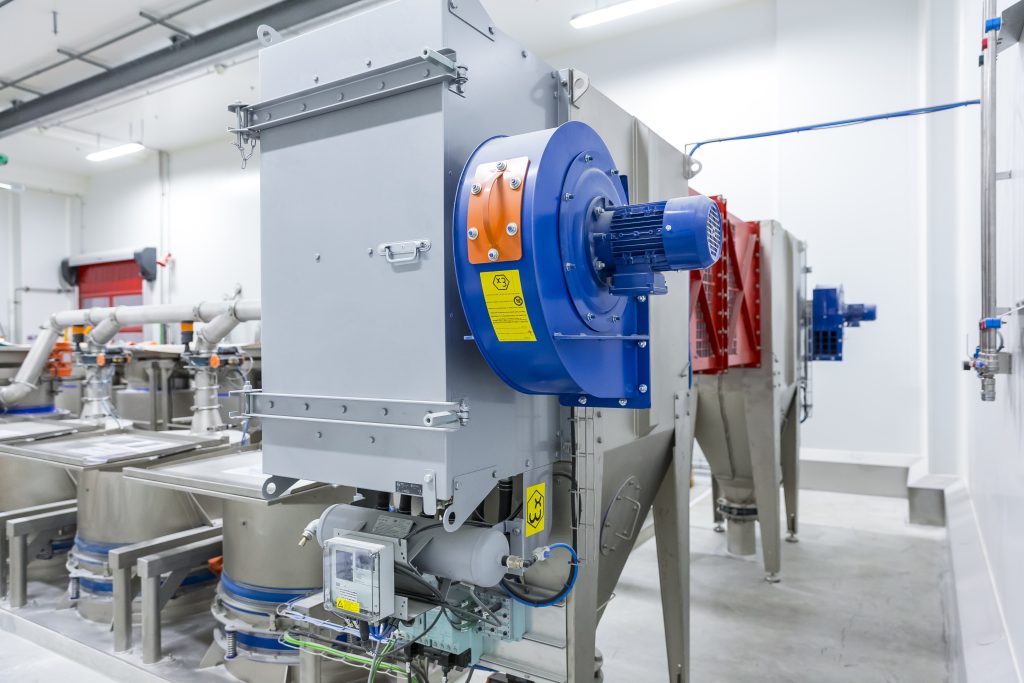
Dust collector unit
All of these solutions require dust management—this is the issue of dust collection. Often neglected or even overlooked, it must be taken into account, as the removal of extracted fine particles requires well-designed access and flow management that meet your safety and ergonomic requirements.
Pneumatic transfer
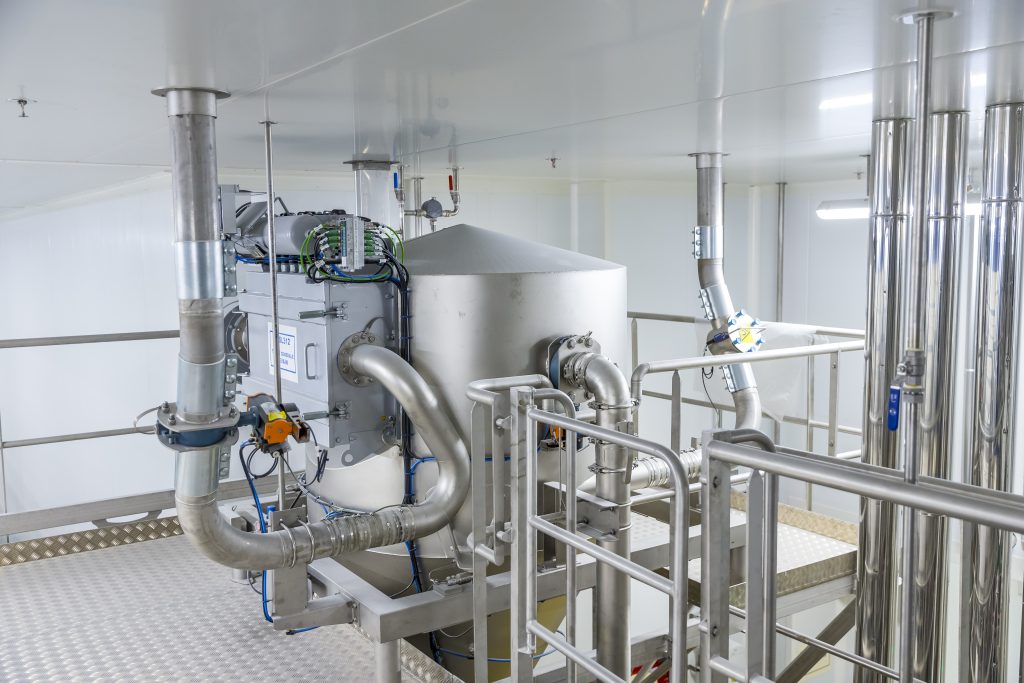
The transfer of all these dry ingredients is a fascinating and highly technical subject. First of all, a basic rule is to prioritize gravity flow whenever possible: it consumes no energy, is often straightforward, and allows for relatively easy cleaning.
Otherwise, the product is conveyed in blown or suctioned air—this is known as pneumatic conveying of ingredients. Dense or dilute phase systems, dedicated to sensitive or pre-mixed products, operating under pressure or vacuum—there are many possible configurations.
We remain strong advocates of vacuum pneumatic conveying solutions, as they reduce the risk of product leakage outside the conveying lines. Once again, the available solutions are numerous and address a wide range of technological requirements. The key is to identify the one best suited to your specific needs, and we are ready to support you in making that choice.
One competitive option is to use screws to convey ingredients. This solution is efficient in many cases as well as short distance and direct layouts.
Filtration and HACCP
Screening equipment, sifters, vibrating tables, as well as magnetic traps should be positioned as close as possible to the points of use.
Access must be carefully considered and designed to be safe and ergonomic for operators responsible for HACCP controls and for maintenance. Make your choices based on requirements for easy disassembly and cleanability, ensuring optimal safety and ergonomics.
Ingredient dosing
Ingredient dosing is, of course, a strategic step, as it confirms whether the production recipe has been properly followed. Today, a large proportion of solutions are automated and autonomous.
In our view, two key design priorities emerge in this fascinating technical field: first, defining your expected level of dosing accuracy; and second, defining your required level of protection against cross-contamination.
Be particularly cautious, as some solutions may appear attractive from an automation standpoint but may prove poorly suited to stringent requirements for full equipment disassembly in order to perform thorough cleaning between two recipes.
Once again, let us first define your constraints so we can explore the appropriate options—accessibility, inspection hatches, quick-release dismantling, duplicated equipment, CIP systems, or forced emptying—that will become your dedicated solutions.
Our recommendations
Alongside automated installations, do not overlook the advantages of manual dosing stations, which can address specific challenges such as micro-dosing or the prevention of cross-contamination.
Are you familiar with solutions that combine manual dosing with automated transfer? Or fully automated micro-dosing with manual incorporation? We would be pleased to introduce them to you.
Finally, do not underestimate the role of cooling, which remains a key factor in controlling the temperature of certain ingredients. This is particularly true for flour cooling processes, which require connection to a glycol water network.
And keep an eye also on crucial ATEX challenges.
Conclusion
To conclusion, the stages of storage, transfer, and dosing are the initial steps in the baking industry. There is a vast array of technical solutions available on the market, catering to every need, level of requirement, and budget. The goal is to find the solution that meets your specific needs while anticipating future developments, always keeping industrial operator safety as the top priority. Your objective is to make the right design choices and clearly define your expected performance levels.
For example, regarding ingredient supply, are bulk solutions better suited than refillable containers such as bags and big bags? It is also important to consider that each technical solution for transfer and dosing comes with its own advantages and limitations, which is why clearly understanding your needs is essential to match them with the most appropriate technical solution.
This article was written by Hopi Consulting, engineering dedicated to the baking industry.
Discover more articles on the Hopi Consulting blog dedicated to the baking sector.