Leading investment decisions today in the baking industry is a challenging task; itcomesdownto looking for clarity in an environment that is entirely unpredictable due to economic, social, political, geostrategic, climate, and energy uncertainties…
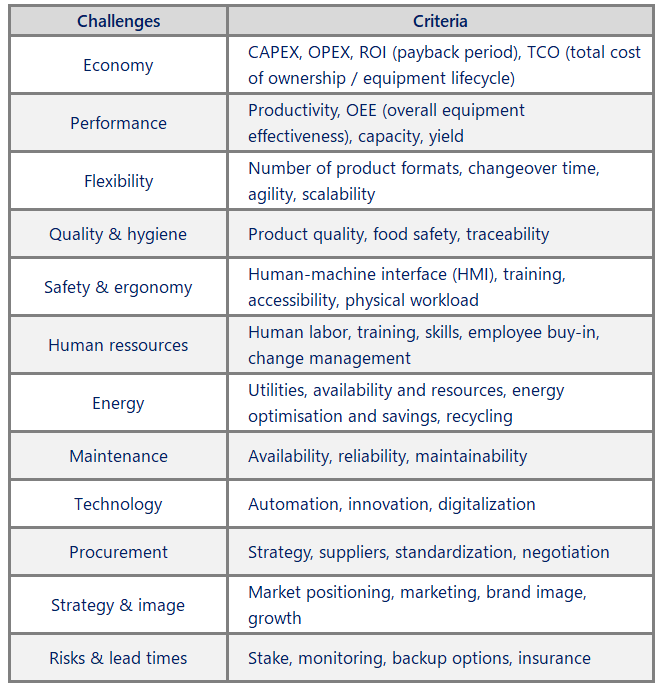
Securing industrial investment in the baking industry sector means having complete control over a variety of challenges: CAPEX, OPEX, productivity, flexibility, quality, hygiene, safety of people and equipment, labor, energy, quality, marketing innovation, deadlines… Not forgetting the less tangible but always present challenges: human relationships (always), assertiveness, and the company’s image, strategy, and purchasing policies…
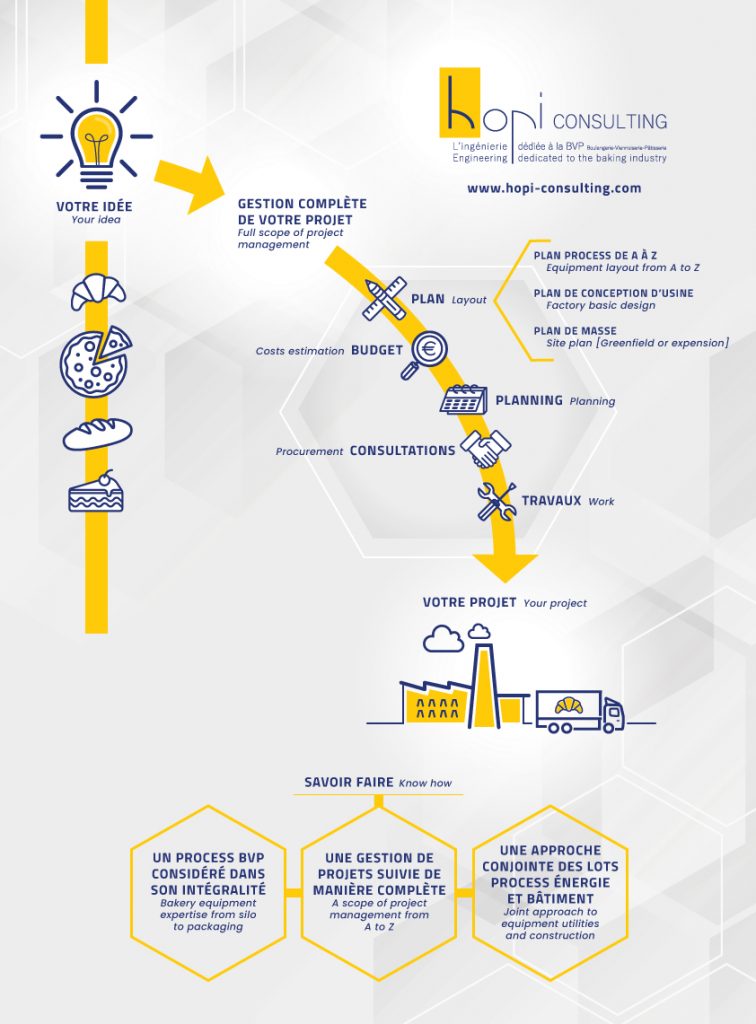
Hopi consulting is the only engineering consultancy that’s exclusively specialized in the baking industry. Focus on this single sector allows us to offer concrete industry expertise and a guarantee of custom solutions dedicated to the world of the baking industry. Moreover, our global approach covers equipment, utilities, and infrastructure: it gives our clients a sharing of skills and experience that builds our strength and makes the company unique. Finally, Hopi consulting stands out for its complete independence in selecting equipment manufacturers and process suppliers, the only guarantee of an impartial approach.
Take the opportunity of this article to discover the company AGENIAA, specializing in the Bakery, Viennoiserie and Pastry industry, whose strategy is to support its clients in gaining greater control over their investments.
Special thanks to Geoffroy CARO for his contribution to this article.
How to put under control an investment in the baking industry ?
Successfully delivering an industrial investment starts with understanding the entire ecosystem of objectives involved. Each objective impacts the core of your project. The first step is to identify all these objectives and assess each one individually.
The exercise consists of balancing challenges according to your investment strategy.
This stage is one of the most important because it will set the direction and guide you toward a successful investment aligned with your goals.
1. The challenge of producing more while keeping costs under control
Dreams broken by the confusion between instant capacity and nominal capacity
A lexical misunderstanding is unfortunately at the root of the disagreements between the supplier and the client once the project is running.
Indeed, the term « capacity » isn’t detailed enough. From the supplier’s perspective, we talk about the nominal capacity, meaning the maximum manufacturer rate in an environment where the usage conditions are ideal.
However, the end user’s perspective is quite different, focusing instead on the instantaneous production capacity, which reflects the actual output of the line at the time of measurement. It takes in consideraton the disturbances inherent to the proper functioning of the line, for which the equipment supplier is not necessarily responsible. These impacts come from the production environment, which is never perfect in real-world operating conditions. Here are many impacts due to the products, the operators, and the conditions of the room…
Finally, there is the average and real capacity measured over a full day, week, or month.Takingintoaccount planned and unplanned downtime, including breakdowns and stoppages for maintenance or cleaning. Anadditionalgapcomparedwiththenominalproduction efficiencyinitiallyspecifiedbytheequipmentsupplier.
If the nominal capacity was used as the basis for establishing an annual production plan to determine sales prediction, the production capacity deficit can be significant.
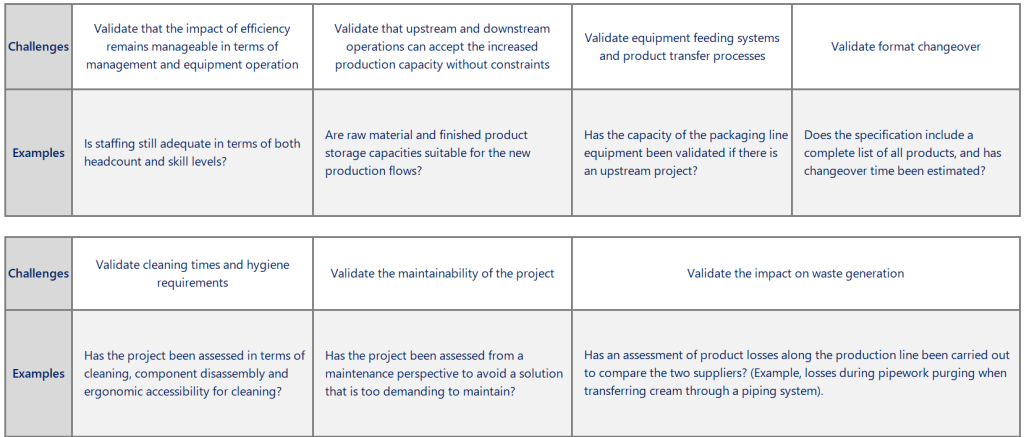
A successful project requires a broad perspective to understand its upstream, downstream, and crosswise environment
The second observation is the lack of an overall consideration of the project, When in fact it will impact all areas of its environment.
Technical question: How can production efficiency increases can be secured ?
We can then introduce automation, conveyor, handling, storage solutions, etc.
2. Meeting demand requiring more and more flexibility
The success of an investment often hinges on an impossible equation: achieving the best production efficiency while offering a broader product range.
The challenge of producing ever faster while introducing new formats leads to more disappointments than successes.
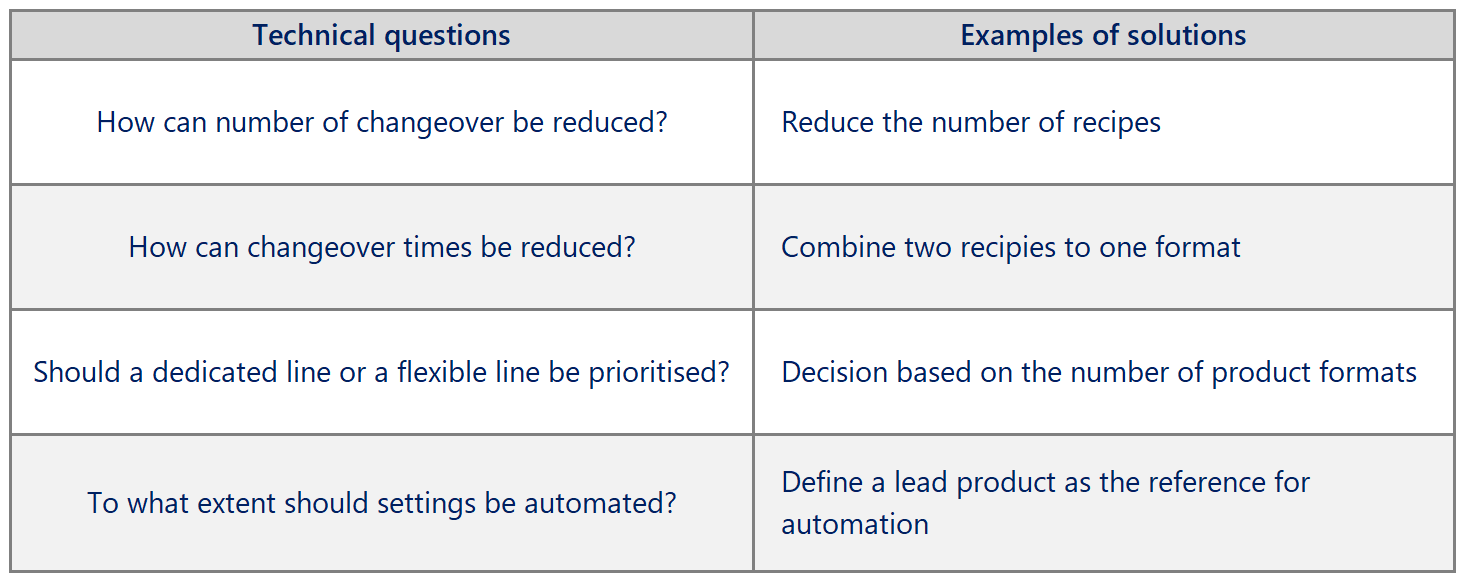
In other words, the work begins before meeting with suppliers. It starts internally, by screening the product catalog, with two objectives: reducing the number of formats as much as possible and reducing the number of low-volume SKUs. The technical assessment can begin only once this process is complete.
At the end of this study, exploring the separation of the production of major and minor product ranges will be beneficial. This approach will ensure that the project’s high production efficiency are maintained by minimising the number of format changeovers. Low-speed production will be excluded from the project and located either to a simpler, less ambitious secondary line or to an existing production line.
3. Reduce dependence on human labour
The availability and cost of labour are becoming key factors in baking industry projects. A project often needs to be designed to overcome these constraints.
There are two key labour-related objectives: reducing reliance on manual labour and improving working conditions.
The objective is therefore not necessarily to eliminate the operator, but to reduce repetitive and physically demanding tasks.
This leads us to consider:
Mechanisation / Automation / Robotisation
Exemple : Finished-product case-packing station can be redesigned to replace manual workstations with automated or robotised operations. Mechanised gravity discharge solutions, conveying system discharge solutions, or using automated or robotised equipment that replicates human movements.
Ergonomic workstations or manual handling aids
Exemple : The workstation, which requires operators to lift bags of raw materials and empty them into an ingredient hopper, can be improved without requiring a complete redesign. Installing a bag-handling system to eliminate the need to lift and transfer bags from their storage pallet to the discharge point improves operator comfort and reduces physical strain.
4. Improve food quality and safety, and excel in innovation.
Baking industry consumer expectations and market are moving towards two noticeable trends : standardisation and premiumisation. The first aspect of uniformity is constrained by retail buying groups and their commercial specifications. Despite their inherently variable nature, baking products are produced and marketed according to standards that standardises them. The second criterion reflects a market trend, the low-cost approach is becoming less commercially attractive. By contrast, high-quality products that embody key values (taste, corporate social responsibility CSR, trends…), becomes a target for consumers.
The quality challenge in the baking industry today is to strengthen control over compliance with production and marketing standards.
This exercise requires, for example, a more in-depth analysis of certain actuals steps of the process :
The impact of temperature and humidity
Challenges of crust formation during cooling
Product shelf life and storage conditions
Innovation obviously remains a key concern for the project. It must be based on market intelligence, prospecting, but also creativity…
5. Keep energy consumption under control
Energy is playing an increasingly important role in technological decision-making today. Faced with rising energy costs and environmental challenges, energy consumption is becoming a key factor in the selection of equipment and technical solutions.
The question “How much does this machine cost?” must become “How much will it cost to run in terms of energy over the coming years?”
All energy sources must be Included in the assessment :
Electricity
Gas
Steam
Cooling
Compressed air.
But are water consumption also taken into consideration, allongside energy recovery challenges and cycle optimization?
6. A smarter, more connected factory
One final challenge that is becoming unavoidable is data management.
Modern equipment is no longer limited to manufacturing operations; it also generates data, including:
Efficiency
Real-time measurements, such as temperature
Ratios such as yields and consumption
Downtimes
Defects
We have moved from “a machine that produces” to “a machine that produces and communicates.”
This naturally opens up new possibilities in automation, process monitoring, Manufacturing Execution Systems (MES), traceability and quality control. People and their skills must not be overlooked, because collecting data without the ability to analyze and interpret it makes no sense.
COMPANY OVERVIEW - JV AGENIAA
Founded in 1999, JV AGENIAA has progressively grown by building around its specialised expertise in the supply of equipment and solutions for the food processing industry.
Originally specialising in the baking industry, the company has gradually expanded its offering to other areas of the food processing industry. Over the years, it has also strengthened its position as a production line integrator, supporting customers throughout the entire project lifecycle, from equipment selection and testing to installation and the delivery of complete turnkey projects.
Key figures :
Established :1999
Employees : 16 employees
Location : Fleury-sur-Orne, Normandy, France
Revenue : €9 million (2025)
Industry : Equipment and solutions for the food processing industry.
Specialisations : Baked products, biscuits, prepared foods, and more.
Areas of Operation : France and Europe.
Its growth is driven in particular by a portfolio of equipment manufacturers and specialised technologies, combined with an approach that brings together technical expertise and dedicated support for industrial clients.
A partner ecosystem
JV AGENIAA relies on a network of European manufacturers and technology partners well known in their respective fields of expertise.
This ecosystem enables the company to combine technologies and complementary expertise to provide each customer with solutions designed for their needs and industrial constraints.
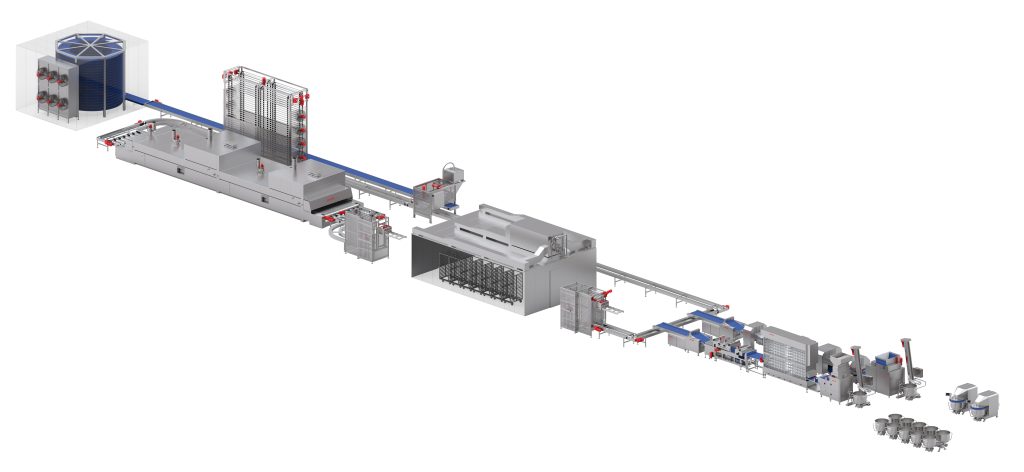
Its portfolio of partners covers the main steps of food processing, from raw material preparation and dough mixing to shaping, dosing, proofing, baking, cooling, and packaging. This complementarity enables JV AGENIAA to deliver both individual equipment and complete projects.
Tonelli Group is an Italian manufacturer specialising in mixing equipment for the food processing industry. The company designs mixers for bakery (planetary, horizontal, centrifugal, continous, premixer), pastry production and various food applications, as well as mixing solutions incorporating functions such as heating, cooling and vacuum processing.
Polin is an Italian manufacturer specialising in baking equipment for the bakery and pastry industries. The company designs deck ovens, rotary rack ovens, and tunnel ovens, intended for both artisan workshops and industrial production lines.
VEMAG is a German manufacturer specialising in food processing equipment since 1944. In the bakery industry sector, the company develops solutions for dough dividing enabling different types of dough to be processed with precision and consistency.
Sveba Dahlen is a Swedish manufacturer specializing in baking equipment for the bakery and pastry industries. Its product range includes deck ovens, rotary rack ovens, and tunnel ovens designed to meet the needs of both artisan bakeries and industrial production facilities.
Shuffle-Mix is a Dutch company specializing in mixing and cream aeration equipment for the bakery and pastry industries. Its systems are designed for the continuous aeration of creams, biscuit mixtures and other pastry preparations.
PANEM is a French manufacturer specializing in cooling and proofing solutions for the bakery and pastry industries. Since 1969, the company has developed controlled proofing cabinets and rooms, as well as cooling and freezing equipment adapted to the needs of both artisan bakeries and industrial production facilities.
CANOL is an Italian manufacturer specialising in machinery and production lines for the bakery and pastry industries. Founded in 1973, the company offers solutions for dough sheeting and extrusion, shaping, and the production of viennoiseries and speciality breads, as well as dosing and injection equipment for both artisan and industrial production.
An integrator approach
The value of AGENIAA does not lie in representing manufacturers’ brands, but in its ability to select technologies and make them work together into a coherent industrial project that solves a specific industrial challenge.
Case Study: A Real-Life Example
Case Study: A Real-Life Example
In 2025, JV AGENIAA supported a French biscuit and cookie manufacturer in optimizing its production capacity. To address existing equipment bottlenecks, AGENIAA installed a high-performance divider equipped with specialized modules adapted to the manufacturer’s needs. This solution improved productivity and product compliance, with an estimated return on investment of less than 18 months. This partnership supports the company’s growth, enabling it to triple its revenue.
Today, industrial bakery, viennoiserie and pastry manufacturers must increase production while keeping costs, quality and flexibility under control. JV AGENIAA supports this evolution by providing solutions that improve productivity, automate processes and scale up production capacity to meet future needs.
The value of JV AGENIAA also lies in the complementary expertise of its teams : sales, food technologists, sales administration, capital projects and after-sales service. Each team contributes at a key stage of the project, from needs assessment to trials to integration, to commissioning and performance monitoring.
This organisation ensures that technology serves the customer’s practical needs, while providing long-term support.
A Future-Oriented Vision
The investment by FrenchFood Capital in Groupe JV and Geoffroy Caro‘s arrival as head of JV AGENIAA mark the beginning of a new phase of growth for the company. Through its three-year strategic plan, JV AGENIAA aims to strengthen its role as an industrial partner in the baking industry, building on its network of technology partners, its process expertise and the complementary skills of its teams. In an environment driven by growing challenges related to productivity, automation, flexibility and cost control, the company aims to continue developing overall solutions to support its customers throughout their industrial projects, from initial thinking to production start-up.
An ambition rooted in one conviction: production excellence depends on the quality of integration.
CONCLUSION
As a turnkey integrator, JV AGENIAA is commits to assess all challenges of a project as a whole, anticipating potential constraints and creating the right conditions for its success.
As you will have gathered, project success is not measured solely by finished product quality and production efficiency. It also requires a broader perspective, taking into account the challenges outlined above (flexibility, workforce requirements and energy consumption management…)
In a constantly evolving market, this holistic approach is a key driver in designing sustainable, scalable solutions that meet future requirements while ensuring production performance and competitiveness.
Hopi consulting supports you throughout this process, providing customised technical support, independent and100% dedicated to the bakery, viennoiserie and pastry (BVP) sector.
Discover our technical support services on our website.
This article was written by Hopi consulting, the engineering consultancy dedicated to bakery, viennoiserie and pastry. Discover more articles on the blog Hopi consulting dedicated to bakery, viennoiserie and pastry.
Did you like this post ?
Share on Facebook
Share on Twitter
Share on Linkdin
Interested in this article?
Receive our monthly newsletter dedicated to the world of baking industry …
We will never send Spam nor share your email with third parties… promised!